Medicine in motion
Driving as a clinical intervention.
We train medics and drivers together to deliver TCCC-level care inside a moving vehicle — and to drive in a way that protects that care instead of working against it.
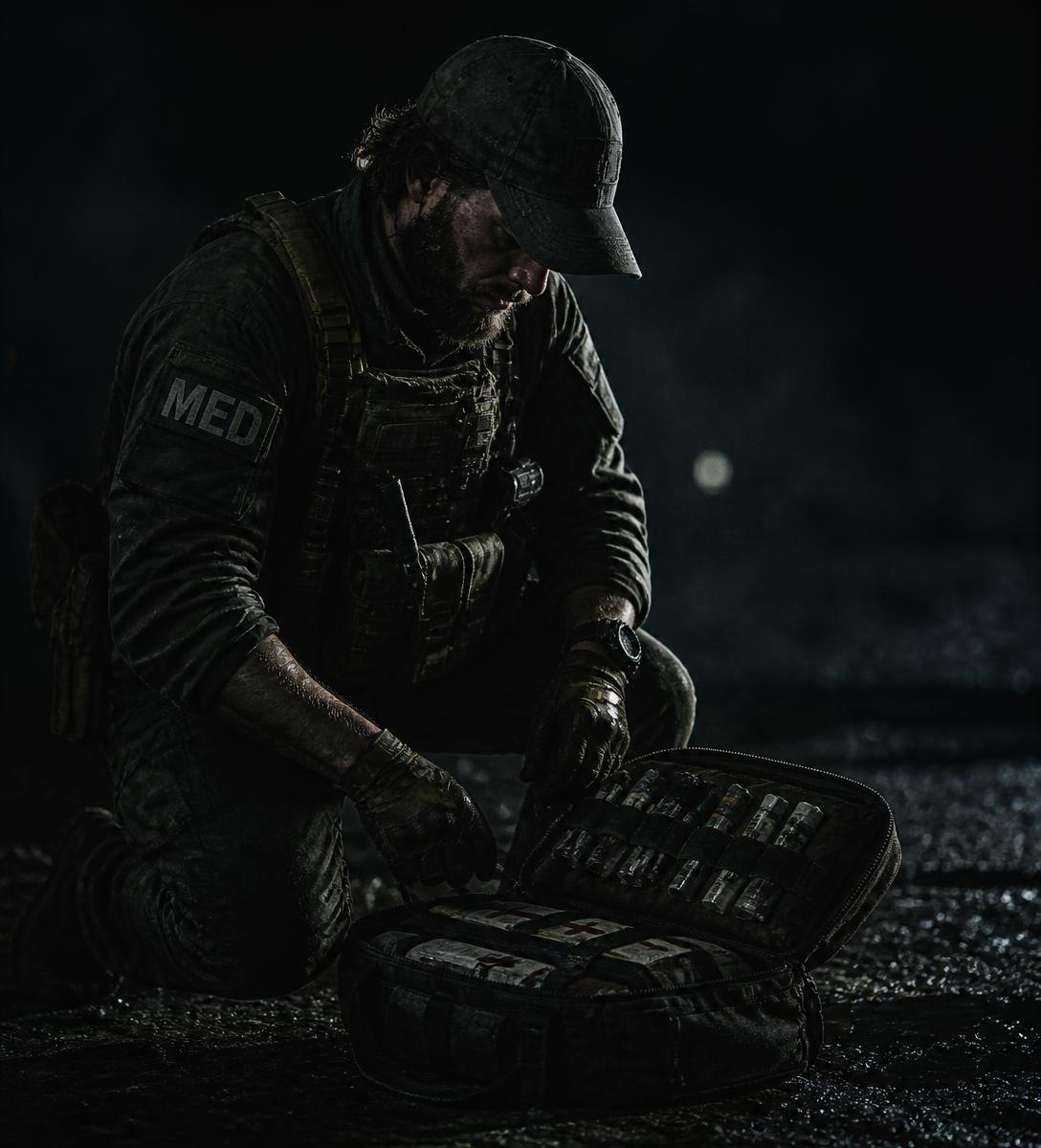
Death on the Battlefield
87.3%
of combat deaths (2001–2011) occurred before the casualty reached a Role 3 facility
01 / Mission
The fight for survival is won or lost before a casualty ever reaches a surgeon.
It is won or lost at the point of injury and during transport. We exist to close that gap by teaching two things as one skill: how to deliver care in the back of a high-speed vehicle, and how to drive in a way that protects that care.
TCCC's TACEVAC guideline tells the medic what to do in transport — hemorrhage control, airway management, reassessment cadence, tourniquet conversion criteria. Almost nothing in published doctrine tells the driver how to drive to protect it: speed selection, braking and cornering technique, route choice, and how the driver and medic communicate mid-transport. That gap is our mission, and we build every course and every kit around closing it.
98%
survival rate for casualties who did reach a Role 3 facility
~10 min
Platinum 10 — the window for life-saving point-of-injury care
2
disciplines taught as one: care under motion and tactical driving
02 / Why now
The golden hour depended on one condition that no longer holds.
The standard built during Iraq and Afghanistan assumed largely uncontested airspace — dedicated MEDEVAC could reach the point of injury and fly straight to a surgical facility. Against a peer threat with persistent drone coverage, that assumption fails. Doctrine is already responding: CoTCCC's proposed Change 25-2 revises tourniquet reassessment using Russo-Ukrainian War data, and the U.S. Army has piloted a Delayed Evacuation Casualty Management course built for evacuation measured in days, not hours.
87.3%
of combat deaths (2001–2011) occurred before reaching a Role 3 facility
3.1x
higher relative risk of casualties for health transports in contested airspace
1,503
verified attacks on health care in Ukraine's first 18 months of war
No air sovereignty
Casualty helicopters cannot fly the way NATO forces did in Afghanistan; ground vehicles now carry a load air evacuation used to.
No protected rear area
Persistent drone coverage means there is no secure zone behind the line to stage or treat casualties safely.
Marked vehicles are not protected in practice
Ambulances and evacuation vehicles marked as medical transports have been struck repeatedly despite legal protections.
Fiber-optic drones defeat jamming
Strike drones guided by fiber-optic cable are immune to radio jamming and hard to detect before impact.
Longer-range strikes push evacuation back
Guided munitions reaching tens of kilometers behind the line force medics to move casualties farther to reach a safe handoff.
03 / The clinical cost of speed
What a high-speed platform takes away from the medic.
Every item below is something we train as a managed variable rather than an accident.
Hemorrhage control degrades
Rough terrain and hard braking loosen or dislodge tourniquets and wound packing, undoing point-of-injury work.
IV/IO access is lost
Vibration and jostling make it difficult to place or maintain lines; existing lines infiltrate or are pulled.
Reassessment becomes impossible
Airway, breathing, and circulation checks require a stable platform the medic often doesn't have at speed.
Stabilization suffers
Splinting and C-spine precautions are undermined by impact loading over damaged roads.
Monitoring and comms break down
Vital sign tracking and radio coordination with the receiving facility both suffer in a fast, rough ride.
Driving becomes the countermeasure
Smooth inputs, speed matched to patient acuity, and joint route calls turn technique into treatment.
04 / Course options
Medical Mobility — a five-day program in two connected phases.
Three days of driving-focused instruction with medical elements introduced in the background, followed by two days of medicine-focused instruction that culminate in a full integrated capstone. Delivered jointly with International Security Academy's tactical driving cadre.
- Pricing
- $2,500–$3,000
- per student, per day
- Delivered at
- ISA / Keystone Heights Airpark, Starke, FL — 5,000-ft runway, skid pad, six firearm ranges, and rally stages on site.
- Audience
- SOF medical elements and all deployable medical teams, trained alongside their drivers.
- Day 1Phase 1 — Driving focus
Foundations
- Full instructor demonstration of every stage of the course
- Steering, braking, and skid-pad weight-transfer fundamentals
- Driver-medic comms lexicon introduced as a running thread (brace, hole, hard brake, hard left/right)
- Day 2Phase 1 — Driving focus
Applied tactical driving
- Cornering and braking technique under load; route and terrain selection drills
- Winch practical, so no student operates a winch for the first time during a graded exercise
- Patient-loading familiarization across vehicle platforms — no live care yet
- Day 3Phase 1 — Driving focus
Integration under load
- Timed driving evaluation runs with a simulated patient aboard
- Comms lexicon in live use between driver and back-of-vehicle
- Closes with a driver-side after-action review
- Day 4Phase 2 — Medicine focus
TCCC-in-motion skills
- Hemorrhage control, airway management, and reassessment cadence drilled inside a moving vehicle
- Each TCCC TTP broken into discrete, teachable movement segments
- Tourniquet application and conversion trained to the proposed Change 25-2 standard
- Progression from stationary-vehicle reps to moving-vehicle reps
- Day 5Phase 2 — Medicine focus
Capstone integration
- Continuous TCCC-in-motion care while the vehicle executes tactical driving
- Comms, casualty status calls, and route/speed decisions made jointly by driver and medic
- Combined instructor and student after-action review with same-day feedback capture
- Also availableScope a program
Scoped and unit-specific delivery
Shortened driver-medic integration blocks, platform-specific patient-loading instruction, and mobile delivery scoped to your vehicles, tempo, and risk profile.
05 / Kit line
Purpose-built kits, staged for the field.

Kit
Individual IFAK — Filled & Assembled
A complete, field-ready individual first aid kit assembled to TCCC standards and staged for point-of-injury care. Every component is packed in a large rip-away MOLLE pouch so the kit comes off the platform in one motion.Contents CAT Tourniquet — Gen 7 (Combat Application Tourniquet) × 2 QuikClot Combat Gauze, Z-Fold × 2 Kerlix Gauze Roll, 4.5" x 4.1yd × 2 ACE Elastic Bandage, 6" with clips × 3 Nasopharyngeal Airway (NPA), 28Fr × 1 SAM Chest Seal 2.0 — Vented × 2 Needle Decompression Kit, 14ga x 3.25" × 2 Israeli Battle Dressing, 6" × 2 XSTAT 30 Applicator × 1 Nitrile Exam Gloves (pair) × 1 Permanent Marker (fine point) × 1 TCCC Casualty Card × 1 IFAK Pouch — Rip-Away MOLLE, Large × 1

Kit
Large Medical Mobile Kit
A team-level medical kit built for mobility platform medicine — enough capability to treat and sustain multiple casualties in transport. Packed in a STOMP medic backpack for fast movement between vehicle and casualty.Contents CAT Tourniquet — Gen 7 (Combat Application Tourniquet) × 4 QuikClot Combat Gauze, Z-Fold × 4 Kerlix Gauze Roll, 4.5" x 4.1yd × 4 ACE Elastic Bandage, 6" with clips × 6 Nasopharyngeal Airway (NPA), 28Fr × 2 SAM Chest Seal 2.0 — Vented × 4 Needle Decompression Kit, 14ga x 3.25" × 4 Israeli Battle Dressing, 6" × 4 XSTAT 30 Applicator × 2 Nitrile Exam Gloves (pair) × 2 Permanent Marker (fine point) × 2 TCCC Casualty Card × 2 SAM Junctional Tourniquet × 1 Stethoscope — Littmann Classic III × 1 IV Catheter, 18ga x 2.0" × 4 IV Administration Set, 10 gtt × 2 IV Administration Set, 15 gtt × 2 Lactated Ringers, 500mL Bag × 2 SAM Splint, 36" × 3 Cravat / Triangular Bandage × 3 Combat Eye Shield × 1 Glucometer Kit (meter, strips, lancets, control solution, case) × 1 Medic Backpack — STOMP Bag × 1

Kit
Vehicle Trauma Bag — Platform Mounted
A mounted trauma bag sized for the crew compartment and rigged to stay put at speed. Two-strap MOLLE mounting keeps it fixed to a seat back or bulkhead so it doesn't become a projectile, and the single-pull opening exposes every hemorrhage-control item at once.Contents CAT Tourniquet — Gen 7 × 4 QuikClot Combat Gauze, Z-Fold × 4 Israeli Battle Dressing, 6" × 4 Kerlix Gauze Roll, 4.5" x 4.1yd × 4 Vented Chest Seal, twin pack × 2 Needle Decompression Kit, 14ga x 3.25" × 2 Nasopharyngeal Airway, 28Fr × 2 Trauma Shears × 1 Nitrile Exam Gloves (pair) × 4 TCCC Casualty Card × 4 Mounted Trauma Bag with MOLLE straps × 1

Kit
Driver's Reach Kit — Console IFAK
A flat, low-profile kit built for one job: the driver treating themselves or the front passenger without leaving the seat. Sized for a console, door pocket, or seat-side panel and reachable one-handed while belted in.Contents CAT Tourniquet — Gen 7 × 1 QuikClot Combat Gauze, Z-Fold × 1 Vented Chest Seal × 1 Israeli Battle Dressing, 4" × 1 Trauma Shears × 1 Nitrile Exam Gloves (pair) × 1 Permanent Marker (fine point) × 1 Low-Profile Flat Pouch × 1

Kit
Rear Compartment Casualty Panel
A roll-out panel that turns the back of a vehicle into a working treatment surface. Every item is retained in an elastic loop so nothing shifts under hard braking or cornering, and the layout is ordered to the TCCC sequence so the medic works left to right without searching.Contents CAT Tourniquet — Gen 7 × 4 QuikClot Combat Gauze, Z-Fold × 4 Vented Chest Seal, twin pack × 2 Needle Decompression Kit, 14ga x 3.25" × 2 Nasopharyngeal Airway, 28Fr × 2 Bag-Valve Mask, adult × 1 IV Catheter, 18ga x 2.0" × 4 IV Administration Set, 10 gtt × 2 Lactated Ringers, 500mL Bag × 2 Israeli Battle Dressing, 6" × 4 SAM Splint, 36" × 2 Roll-Out Retention Panel with mounting grommets × 1

Kit
Litter & Extraction Package
Everything needed to get a casualty out of a vehicle, onto a platform, and secured for movement. Built around packaging speed — the part of transport that most often costs time.Contents Roll-Up Tactical Litter × 1 Casualty Drag Strap × 1 Retention Straps, 5-point × 1 set Locking Carabiners × 4 Hypothermia Prevention Wrap × 1 Cravat / Triangular Bandage × 4 SAM Splint, 36" × 2 Cervical Collar, adjustable × 1 Compression Roll Carry Bag × 1

Kit
Junctional Hemorrhage Module
A dedicated module for the bleeding a limb tourniquet cannot reach — groin, axilla, and pelvis. Sized to ride alongside a primary bag so junctional capability is never the thing left behind.Contents SAM Junctional Tourniquet × 1 QuikClot Combat Gauze, Z-Fold × 4 XSTAT 30 Applicator × 1 Pelvic Binder × 1 Israeli Battle Dressing, 6" × 2 Nitrile Exam Gloves (pair) × 2 Permanent Marker (fine point) × 1 Module Pouch × 1

Kit
Airway Module — In-Motion
Airway status is dynamic in transport, and it is the intervention most punished by a moving platform. This module keeps every airway option in one pouch, ordered simplest to most invasive, so the decision is fast and the hands know where to go.Contents Nasopharyngeal Airway, 28Fr × 2 Supraglottic Airway Device × 1 Bag-Valve Mask, adult × 1 Surgical Cricothyrotomy Kit × 1 Manual Suction Device × 1 Lubricating Jelly Packets × 4 Commercial Tube Securing Device × 1 Module Pouch × 1

Kit
IV / IO Access & Fluids Module
Vascular access is the first skill vibration takes away. This module pairs IV and intraosseous options so the medic has a fallback the moment a line will not seat in a moving vehicle.Contents IO Driver with 25mm and 45mm Needle Sets × 1 IV Catheter, 18ga x 2.0" × 4 IV Catheter, 20ga x 1.16" × 2 IV Administration Set, 10 gtt × 2 IV Administration Set, 15 gtt × 2 Lactated Ringers, 500mL Bag × 2 Saline Lock × 2 Venous Constricting Band × 1 Alcohol Prep Pads × 10 Catheter Securing Dressings × 4 Module Pouch × 1

Kit
Prolonged Casualty Care Resupply Module
Built for the evacuation that takes hours or days instead of minutes. Sealed resupply bundles let a medic re-dress, re-warm, and keep documenting long after the initial kit is spent.Contents Gauze & Dressing Resupply Bundles × 4 Kerlix Gauze Roll, 4.5" x 4.1yd × 6 ACE Elastic Bandage, 6" × 4 Hypothermia Prevention Wrap × 2 Active Warming Blanket × 1 Lactated Ringers, 500mL Bag × 4 Urinary Catheter Kit × 1 Oral Rehydration Salts × 6 Casualty Documentation Cards × 10 Resupply Duffel × 1

Kit
Convoy Mass Casualty Roll
A convoy-level bag for the event that produces more casualties than medics. Pre-packed single-casualty response packs let untrained hands be given a bundle and a task instead of digging through a shared kit.Contents Single-Casualty Response Packs (TQ, gauze, dressing, seal, gloves) × 8 CAT Tourniquet — Gen 7, loose stock × 8 Israeli Battle Dressing, 6" × 8 Vented Chest Seal, twin pack × 4 Triage Tags × 20 TCCC Casualty Cards × 20 Casualty Drag Straps × 2 Roll-Up Tactical Litter × 2 Hypothermia Prevention Wrap × 4 Mass Casualty Duffel × 1

Kit
Care-Under-Motion Training Kit
A reusable trainer set for drilling TCCC skills inside a moving vehicle without burning live inventory. Sized so a two-man driver-medic team can run repetitions on the same platform they operate.Contents Trainer Tourniquets (blue) × 4 Wound Packing Trainer Block × 2 Simulated Blood Concentrate × 1 Trainer Chest Seals, reusable × 4 Trainer Nasopharyngeal Airway ×: 2 Dry-Erase Casualty Cards × 10 Timer / Shot Clock × 1 Instructor Cue Cards — driver-medic comms lexicon × 1 set Training Case × 1
06 / Who delivers this
A driving cadre and a dedicated program medical team.
Medical Director
Dr. Sheldon Tepperman
Clinical governance and curriculum sign-off for the program.
Military Liaison
Dr. Keith Berry
SME in military medicine and doctrine alignment.
Tactical driving
ISA Instructor Cadre
Driving delivery and evaluation across every vehicle platform used in the course.
Director of Operations
Bailey Thomas
Scheduling, unit coordination, and partnership inquiries.
07 / Mobilize
Ready when the door seals. Book a team assessment.
Tell us your platform, your tempo, and your risk profile. We'll scope a training plan and kit loadout mapped to how you actually operate.
Assessment intake